← Previous | 🏠 Home | Next →

Overview
This module serves as your ultimate, comprehensive reference guide. It contains a massive English-Persian glossary of over 100 essential AI terms, extensive cheat sheets for prompt engineering across different disciplines, and robust quick reference tables for tool selection and model comparisons.
We highly recommend bookmarking this page or printing the cheat sheets to keep by your desk as you navigate the AI landscape.
Comprehensive EN ↔ FA AI Glossary

Comparative taxonomy and conceptual hierarchy across Artificial Intelligence (AI), Machine Learning (ML), Deep Learning (DL), and Generative AI (GenAI)
This glossary covers everything from foundational machine learning concepts to the latest terminology in generative AI and prompt engineering.
| English Term | Persian Translation | Brief Definition |
|---|---|---|
| Core Concepts | ||
| Artificial Intelligence (AI) | هوش مصنوعی | The broad field of creating computer systems capable of performing tasks that typically require human intelligence. |
| Machine Learning (ML) | یادگیری ماشین | A subset of AI where algorithms learn patterns from data rather than being explicitly programmed. |
| Deep Learning (DL) | یادگیری عمیق | A subset of ML utilizing multi-layered (deep) artificial neural networks to solve highly complex problems. |
| Neural Network | شبکه عصبی | Computing architecture inspired by the human brain, consisting of interconnected nodes (neurons). |
| Algorithm | الگوریتم | A specific set of rules or instructions given to an AI to help it learn on its own or solve a problem. |
| Model | مدل | The mathematical representation outputted by a machine learning algorithm after it has been trained on data. |
| Data Mining | دادهکاوی | The practice of analyzing large databases in order to generate new information. |
| Language & Generative Models | ||
| Generative AI | هوش مصنوعی مولد | AI systems capable of generating new, original content (text, images, audio, code) based on learned patterns. |
| Large Language Model (LLM) | مدل زبانی بزرگ | A massive AI model trained on vast amounts of text data to understand, translate, and generate human language. |
| Natural Language Processing (NLP) | پردازش زبان طبیعی | The branch of AI concerned with giving computers the ability to understand text and spoken words. |
| Transformer | ترانسفورمر | A breakthrough neural network architecture introduced in 2017 that underpins modern LLMs (like GPT). It processes sequences of data simultaneously rather than sequentially. |
| GPT (Generative Pre-trained Transformer) | جیپیتی | A specific family of LLMs developed by OpenAI. |
| Token | توکن | The fundamental unit of data processed by an LLM. A token can be a word, part of a word, or a single character. |
| Context Window | پنجره متن (حافظه زمینه) | The maximum number of tokens an LLM can analyze or generate in a single interaction. Determines its “short-term memory.” |
| Foundation Model | مدل پایه | Large, generalized AI models trained on vast, unlabeled datasets that can be adapted to a wide range of specific tasks. |
| Model Training & Mechanics | ||
| Parameter | پارامتر | The internal variables or “weights” that the model learns during training. More parameters generally mean a more capable model. |
| Pre-training | پیشآموزش | The initial phase where an LLM is trained on massive amounts of uncurated web data to learn language structure. |
| Fine-tuning | تنظیم دقیق (فاینتیونینگ) | The secondary phase where a pre-trained model is trained on a specific, high-quality dataset to excel at a specific task (e.g., medical diagnosis). |
| RLHF (Reinforcement Learning from Human Feedback) | یادگیری تقویتی با بازخورد انسانی | A technique used to align LLM behavior with human preferences by rewarding good answers and penalizing bad ones during training. |
| Overfitting | بیشبرازش | A modeling error where an AI learns its training data too perfectly, making it unable to perform well on new, unseen data. |
| Underfitting | کمبرازش | When an AI model cannot capture the underlying trend of the data and fails to learn the task properly. |
| Epoch | اپوک (دوره) | One complete pass of the training dataset through the machine learning algorithm. |
| Batch Size | اندازه دسته | The number of training examples processed in one iteration before the model’s internal parameters are updated. |
| Loss Function | تابع زیان | A method of evaluating how well the AI’s algorithm models the data. Lower loss indicates better performance. |
| Weights and Biases | وزنها و سوگیریها | The learnable parameters within a neural network that determine the strength of connections between nodes. |
| Prompt Engineering | ||
| Prompt Engineering | مهندسی پرامپت (دستورنویسی) | The specialized skill of crafting precise text inputs to guide an AI to produce optimal outputs. |
| System Prompt | پرامپت سیستمی | High-level, foundational instructions given to an AI (often invisible to the user) that dictate its overall persona, rules, and boundaries. |
| User Prompt | پرامپت کاربر | The specific input, question, or instruction provided by the user in a given interaction. |
| Zero-shot Prompting | پرامپتنویسی بدون نمونه | Asking the AI to perform a task without giving it any prior examples to learn from. |
| One-shot Prompting | پرامپتنویسی با یک نمونه | Providing exactly one example of the desired input/output format before asking the AI to perform the task. |
| Few-shot Prompting | پرامپتنویسی با چند نمونه | Providing several examples to the AI to establish a clear pattern before asking it to generate a response. |
| Chain of Thought (CoT) | زنجیره افکار | A prompting technique that forces the AI to break down complex problems and explain its step-by-step reasoning before providing the final answer. |
| Temperature | دما | A setting (usually between 0.0 and 1.0) that controls the randomness or creativity of the output. 0 is deterministic/factual; 1 is highly creative/random. |
| Top-p | تاپپی (نمونهبرداری هسته) | An alternative to temperature that controls output diversity by restricting the AI’s word choices to the most probable vocabulary. |
| Persona Prompting | پرامپتنویسی شخصیتی | Instructing the AI to adopt a specific role, profession, or character (e.g., “Act as a senior software engineer”). |
| Delimiters | جداکنندهها | Characters (like triple quotes """ or XML tags <data>) used in a prompt to clearly separate instructions from the data to be processed. |
| Advanced Text AI Concepts | ||
| RAG (Retrieval-Augmented Generation) | تولید افزوده شده با بازیابی | A framework that improves LLM accuracy by forcing it to search a specific external database (like company documents) before generating an answer. |
| Embedding | امبدینگ (تعبیه) | The process of converting words, sentences, or images into complex arrays of numbers (vectors) so the AI can process their semantic meaning. |
| Vector Database | پایگاه داده برداری | A specialized database designed to store, manage, and search massive amounts of high-dimensional vector embeddings quickly. |
| API (Application Programming Interface) | رابط برنامهنویسی اپلیکیشن | A set of rules that allows different software applications to talk to each other. How developers integrate GPT-4 into their own apps. |
| End-point | نقطه پایانی | A specific URL where an API can be accessed to perform a specific function. |
| Agentic AI (AI Agents) | هوش مصنوعی عامل (ایجنت) | AI systems capable of pursuing complex goals autonomously over time, planning steps, and using external tools without constant human intervention. |
| Image & Media Generation | ||
| Diffusion Model | مدل پخشی (دیفیوژن) | The underlying architecture of modern image generators (like Midjourney or Stable Diffusion) that creates images by gradually removing mathematical “noise.” |
| Checkpoint | چکپوینت (مدل پایه تصویر) | A fully trained, standalone image generation model. |
| LoRA (Low-Rank Adaptation) | لورا (تطبیق رتبه پایین) | A small, efficient, add-on file used to fine-tune an image model to generate specific characters, styles, or concepts without retraining the whole model. |
| Seed | سید (دانه) | A specific numerical identifier used to initialize the random noise generation. Using the exact same seed and prompt will produce the exact same image. |
| CFG Scale (Classifier Free Guidance) | مقیاس CFG | A setting in image generation that dictates how strictly the AI must adhere to your text prompt. Higher = stricter; Lower = more creative freedom. |
| Inpainting | درونرنگآمیزی | The process of using AI to select and modify a specific portion inside an existing image. |
| Outpainting | برونرنگآمیزی | Using AI to seamlessly extend the borders of an image outside its original frame. |
| Negative Prompt | پرامپت منفی | Explicitly telling the AI what you do not want to see in the generated image (e.g., “blurry, low quality, extra fingers”). |
| ControlNet | کنترلنت | An advanced tool for Stable Diffusion that allows precise control over image generation using structural maps (like edge detection or human posing). |
| Ethics & Safety | ||
| Hallucination | توهم هوش مصنوعی | When an LLM confidently fabricates false information, fake citations, or nonexistent facts because it predicts they sound statistically plausible. |
| Alignment | همسویی | The critical field of research dedicated to ensuring AI systems behave in ways that match human values, ethics, and intended goals. |
| Guardrails | گاردریلها (حفاظها) | Built-in safety mechanisms and filters designed to prevent AI models from generating harmful, illegal, or unethical content. |
| Bias | سوگیری | Unfair prejudices embedded in an AI’s outputs, almost always inherited from biases present in the human-created data it was trained on. |
| Jailbreaking | جیلبریک (دور زدن محدودیتها) | The act of using carefully crafted prompts to trick an AI into ignoring its safety guardrails and system instructions. |
| Red Teaming | تیم قرمز (تست نفوذ) | The process of intentionally attacking an AI system with malicious prompts to identify vulnerabilities and improve its safety defenses. |

Three-stage LLM training lifecycle: unsupervised pre-training, supervised fine-tuning (SFT), and reinforcement learning alignment (RLHF)
Ultimate Prompt Engineering Cheat Sheet

Scikit-learn decision tree cheatsheet for selecting appropriate machine learning algorithms based on sample size and problem type
Mastering these techniques will elevate your AI interactions from basic to professional.
1. The “CREATE” Framework for Perfect Prompts
Use this structure for highly complex requests:
- C – Context: Who are you and what is the situation?
- R – Request: What exactly do you want the AI to do?
- E – Explanation: What are the rules, constraints, or steps?
- A – Audience: Who is this output for?
- T – Tone: What should the voice sound like?
- E – Extras: Provide examples (few-shot) or formatting requirements.
Example Application:
“I am a high school biology teacher in Iran. I need a lesson plan about photosynthesis. It must fit into a 45-minute class, require no lab equipment, and include a 5-question quiz at the end. The audience is 14-year-olds. Use an encouraging and simple tone. Format the output in Markdown with clear headings.”
2. Task-Specific Prompt Templates
A. Writing & Content Creation
- The Style Mimic:
“Analyze the writing style of the following text delimited by triple quotes. Pay attention to tone, sentence structure, and vocabulary. Then, write a 500-word blog post about [topic] mimicking this exact style perfectly.
"""[Insert Text]"""“ - The Devil’s Advocate (For Brainstorming):
“I have an idea for a startup that [describe idea]. Act as a highly critical venture capitalist. Tear this idea apart. Give me the top 5 reasons this will fail, and then suggest 1 pivot that could save it.”
B. Coding & Development
- The Step-by-Step Coder:
“You are an expert Python developer. I need a script that connects to the Twitter API and downloads recent tweets containing ‘[keyword]’.
Constraints:- Use the
tweepylibrary. - Include robust error handling for API rate limits.
- Save the output to a CSV file.
Think step-by-step before writing the code. Then output only the completed code, well-commented.”
- Use the
- The Explainer/Debugger:
“I am getting a
NullReferenceExceptionin the following C# code. Walk me through exactly why this is happening, line by line, as if I am a junior developer. Then, provide the corrected code block.”
C. Data Analysis & Logic
- Chain of Thought (CoT) Master Prompt:
“Solve the following logic puzzle. Do not give me the answer immediately. First, list out all the known variables. Second, state your assumptions. Third, walk through the logical deductions step-by-step. Finally, state the conclusive answer.”
- Data Formatting:
“Take the following messy text data and convert it into a clean, pipe-separated Markdown table. Extract only the Names, Email Addresses, and Phone Numbers. Ignore all other text.”
“Which Tool for Which Task” Reference Guide
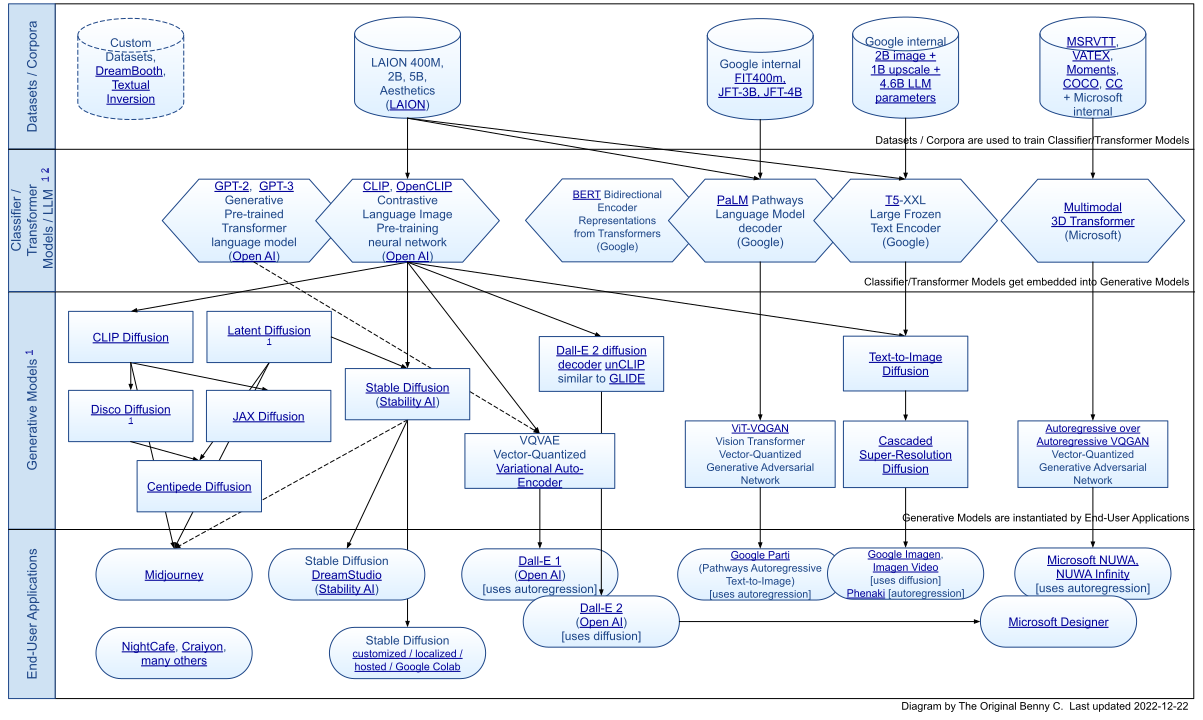
State-of-the-art machine learning model landscape across language, vision, audio, and multimodal paradigms
The AI landscape is crowded. Use this matrix to choose the right tool instantly.
| Task Category | Recommended Premium Tool | Best Free Alternative | Expert Notes & Caveats |
|---|---|---|---|
| General Writing & Ideation | ChatGPT Plus (GPT-4o) | Claude 3.5 Sonnet (Free Tier) | Claude is widely considered to have a more natural, less “robotic” writing style than ChatGPT. |
| Coding & Software Dev | Cursor IDE (Pro) or GitHub Copilot | Claude 3.5 Sonnet (via Web) | Cursor integrates Claude and GPT-4 directly into your VS Code environment, understanding your entire codebase. |
| Web Research & Fact Checking | Perplexity Pro | Perplexity (Free) | Do not use ChatGPT for factual research; Perplexity cites real-time web sources and significantly reduces hallucination. |
| Document Analysis (PDFs, Books) | Claude Pro (Opus/Sonnet) | Google Gemini 1.5 Flash | Claude excels at nuance in large documents. Gemini has a massive context window (1M+ tokens) and can ingest entire textbooks at once. |
| Data Analysis (Excel, CSV) | ChatGPT Plus (Advanced Data Analysis) | Google Gemini | ChatGPT natively runs Python code in the background to analyze files, create charts, and clean data with unmatched accuracy. |
| Photorealistic Image Generation | Midjourney v6 | Bing Image Creator (DALL-E 3) | Midjourney requires a Discord account and is complex to master but yields cinematic results. Bing is easy and uses DALL-E 3. |
| Audio & Music Generation | Udio Pro | Suno (Free Credits) | Both create full songs with vocals from text prompts. Udio currently has slightly better audio fidelity. |
| Video Generation | Runway Gen-3 / Luma Dream Machine | Pika Labs (Free Credits) | Video generation is still in its infancy; expect morphing and artifacts. Prompt carefully. |
| Translation (Eng ↔ Per) | GPT-4o | DeepL / Google Translate | LLMs are now often better at translating nuance and idiomatic expressions than dedicated translation engines. |
Large Language Model (LLM) Comparison Card
As of late 2023 / 2024, these are the titan models.
| Model | Developer | Key Strengths | Key Weaknesses | Best Use Case | Approx. Cost |
|---|---|---|---|---|---|
| GPT-4o | OpenAI | Blistering speed, unparalleled multimodal capabilities (vision, native voice), excellent at coding and logic. | Can be overly verbose, distinct “AI tone” in creative writing. | The ultimate all-rounder. Best for complex logic and voice interaction. | $20/mo (ChatGPT Plus) |
| Claude 3.5 Sonnet | Anthropic | Incredible coding ability, most human-like writing, large 200k context window. | Very strict safety filters can trigger false refusals. Lacks native internet search. | Software development, creative writing, analyzing long PDFs. | $20/mo (Claude Pro) |
| Gemini 1.5 Pro | Massive 1M-2M token context window. Deep integration with Google Docs/Drive. Excellent vision capabilities. | Reasoning can be inconsistent compared to GPT-4o. | Analyzing massive datasets, entire code repositories, or hour-long videos. | $20/mo (Gemini Advanced) | |
| Llama 3 (70B/400B) | Meta | Open-source! Can be downloaded and run locally or on private servers. Fast and highly capable. | Requires significant hardware to run locally. Lacks multimodal features out of the box. | Enterprise developers wanting privacy, researchers building custom local models. | Free (Compute costs apply) |
Hands-on Workshop Exercise
Objective: Combine tools and techniques to solve a complex workflow.
- Scenario: You are tasked with writing a comprehensive report on the “Impact of AI on the Global Job Market” but you only have 30 minutes.
- Research (Perplexity): Go to Perplexity.ai. Use a detailed prompt to ask for a summary of recent statistics on AI job displacement and creation. Ask it to cite at least 3 recent studies.
- Drafting (Claude/ChatGPT): Take the research from Perplexity. Go to Claude or ChatGPT. Use the “CREATE” framework to prompt the AI to write a formal 3-page report based strictly on the provided research data.
- Refining: Use a specific prompt to ask the AI to summarize the report into a 5-bullet-point executive summary.
- Review: Compare the final output against your initial prompts. Did the AI follow all constraints? Share your experience with the class.
← Previous | 🏠 Home | Next →